Ingrown Hair Treatment for Men: Beard, Neck & Razor Bumps
Best Of 2026Updated June 11, 2026Dermatologist Reviewed
Here is the thing almost every “best products for men” list gets wrong: for beard and neck ingrowns — clinically, pseudofolliculitis barbae — the razor in your hand matters more than any serum you can buy. Fix the shave and you prevent most bumps before they start. Most men need two products, not eight. Below is the honest hierarchy: what to change first, the products that actually earn their place across every price range, and the popular ones to skip.
Editorial Team, reviewed by Dr. R. Patel MD
Updated June 11, 2026 • 11 min read • Buyer's Guide
The short version
If you do nothing else: switch to a single-blade safety razor and shave with the grain. That one change prevents more ingrowns than any product. Then add one treatment serum for the bumps you already have. For most men that is the whole routine — a $45 razor and a $34 serum.
Everything below is the detail behind that, plus what to do for darker skin, sensitive necks, and chronic cases that need laser.
We may earn affiliate commissions on purchases through our links, but commissions never influence which products we recommend or how they rank. Read our full affiliate disclosure.
Why men's beard ingrowns are a different problem
Ingrown hairs on legs or a bikini line are mostly about hair re-entering after it's cut. Beard and neck ingrowns are a specific condition: pseudofolliculitis barbae (PFB). Beard hair is thick and, in many men, curved. A curved hair cut to a sharp point can curl straight back into the skin or pierce the follicle wall before it ever exits. Either way your immune system treats the buried hair like a splinter — the red, sometimes pus-topped bump is inflammation, not infection.
Two facts explain almost everything about treating it. First, the neck is worst because hair there grows in swirling, multidirectional patterns, so “shave with the grain” is hardest exactly where you need it most. Second, tightly curled hair is far more prone to PFB, which is why it disproportionately affects Black men — a structural reality, not a hygiene one. If that's you, skin-tone-aware choices (below) matter more than the brand of serum.
This is also why the multi-blade cartridge razor you were sold is the wrong tool. Those work by “lift and cut”: the first blade tugs the hair up, the next cuts it, and the cut end retracts below the skin surface. For PFB-prone skin that is the exact mechanism that buries hairs. Fewer blades, cutting at skin level, is the fix.
Start with the shave — this fixes most of it
Before any product, change how you shave. This is free and it's the highest-leverage move on this page:
Shave with the grain, not against it. Against-the-grain is closer but causes more ingrowns — not worth it for PFB-prone skin.
Don't stretch the skin taut while shaving. Stretching lets you cut below the surface — the same problem as multi-blade razors.
Always prep: warm water or a hot towel for a minute to soften hair, then a slick lather. Never dry-shave the neck.
Use a sharp blade and replace it often. A dragging blade tugs hairs and worsens irritation.
Consider shaving less often — letting stubble reach 1–2 mm gives buried hairs time to surface.
Dermatology guidance, including from the American Academy of Dermatology, lands on the same hardware: a single-blade safety razor or a foil electric, not a multi-blade cartridge. Here are the two that do the job.
9.4/10
Ingrowns Score
Best razor overall
Merkur 34C Heavy Duty Safety Razor
$45 · Double-edge safety razor
The most-recommended razor by dermatologists for PFB-prone men, and the one that does the most work for the least money. The closed-comb head cuts hair at skin level rather than below it — the entire game. There's a short learning curve (let the weight do the work, hold it at roughly 30 degrees), but it pays off within a week or two.
Best for: any man whose neck or jaw bumps up after shaving; the foundation of the routine. The honest downside: a real learning curve, and slower than a cartridge. Buy quality blades separately — the ones it ships with are mediocre.
A foil shaver never cuts below the skin surface, which makes it the safest powered option for PFB and the right pick if a safety razor feels like too much or your neck is extremely reactive. It won't give a baby-smooth finish — and for ingrowns that's a feature, since leaving the hair slightly proud of the skin is what prevents burial.
Best for: men who want speed, hate nicks, or have skin so reactive that any blade contact flares it. The honest downside: expensive at $300, and the shave is noticeably less close than a blade. The battery isn't user-replaceable and degrades over 3–5 years.
Once the shave is fixed, a chemical-exfoliant serum clears existing bumps and keeps follicles open. The active that matters is an acid — salicylic (gets into the pore), glycolic (resurfaces), or mandelic (gentler, good for darker skin). You need one of these, not three.
9.1/10
Ingrowns Score
Best daily serum
Anthony Ingrown Hair Treatment
$34 · Glycolic 10% + salicylic + mandelic
A genuinely well-built blend — 10% glycolic plus salicylic and mandelic — that hits bumps from several angles without the sting of a single high-strength acid. The mandelic acid is the smart inclusion: larger molecule, slower penetration, less irritation, which makes it usable daily on the thin skin of the neck.
Best for: the default pick for most men; daily prevention and clearing existing bumps. The honest downside: the fragrance is divisive — fine in the morning, but some find it noticeable through the day.
At $13 this is the value play. Glycolic and salicylic plus witch hazel do most of what pricier serums do for a fraction of the cost. A little more aggressive, stronger scent, but the actives are legitimate.
Best for: anyone testing whether a chemical exfoliant helps before spending more. The honest downside: witch hazel can dry sensitive skin, and the aftershave-cologne scent is forward.
PFB on darker skin almost always comes with post-inflammatory hyperpigmentation — the dark marks that linger after the bump is gone. This triple-acid formula pairs exfoliating acids with Chromabright, a brightener that fades those marks while the acids handle the ingrowns. It treats both problems at once.
Best for: men with skin of color, or anyone whose ingrowns leave stubborn dark marks. The honest downside: the triple-acid blend is potent — patch test, and start every other day before going daily.
Most men overbuy here. You need a wash that exfoliates where your serum doesn't reach (chest, back, neck) and, if your skin runs dry, a cleanser that doesn't strip. That's it.
8.5/10
Ingrowns Score
Best body wash
CeraVe SA Body Wash
$13 · Salicylic 0.5% + ceramides
A low-dose salicylic wash with ceramides — it gently exfoliates in the shower without wrecking your skin barrier the way a harsh scrub would. For ingrowns on the chest, back, and lower neck it does quiet, consistent work at a drugstore price.
Best for: body ingrowns and daily prevention below the jawline. The honest downside: 0.5% salicylic is mild by design — it prevents and maintains, it won't clear an angry cluster on its own.
If your acids and shaving leave your face tight or flaky, the fix is a non-stripping cleanser, not more product. The unglamorous, reliable choice — it cleans without disrupting the barrier so your serum can work without your skin overreacting.
Best for: men whose skin runs dry or who are layering actives and starting to feel raw. The honest downside: genuinely optional. If your current wash isn't causing problems, skip it.
If you have chronic, severe PFB that hasn't responded to the shave and serum, the only thing that ends the cycle permanently is reducing the hair itself — laser or IPL.
8.4/10
Ingrowns Score
Best for severe / chronic PFB
Braun Silk-Expert Pro 5 IPL
$400 · At-home IPL with skin sensor
An at-home IPL with a skin-tone sensor that, used consistently over a few months, thins and reduces the beard hair causing the problem. Fewer, finer hairs means fewer ingrowns — permanently, for many men. The most expensive option here, but for chronic sufferers cheaper than years of serums.
Best for: men with light-to-medium skin and dark hair, with chronic PFB products haven't solved. The honest downside: the hard limit: IPL is risky on dark skin — it can burn and worsen hyperpigmentation. If your skin is deep, don't use at-home IPL; see a dermatologist for an Nd:YAG laser. And beard removal is permanent, so be sure first.
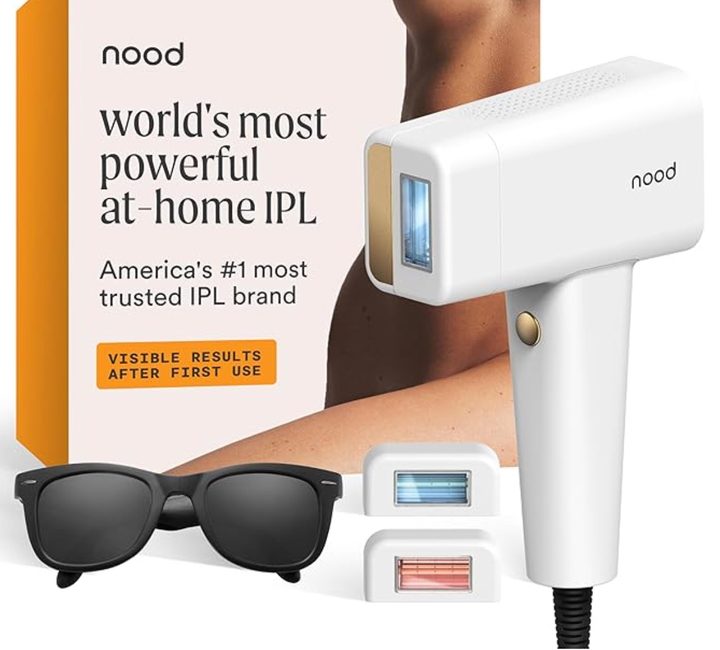
The most credible alternative to the Braun — and arguably the better everyday pick. It's FDA-cleared for permanent hair reduction, the line that separates a real device from the no-name units flooding Amazon, and it's designed with dermatologists. The standout perk is a lifetime flash guarantee: it ships with 600,000 flashes (decades of full-body use) and Nood replaces the handset if you ever run out. Users specifically report ingrown and folliculitis bumps clearing after a few weeks of consistent use — exactly what you're here for.
Best for: men who want a credible, FDA-cleared at-home IPL with a lifetime guarantee, at a bit less than the Braun. The honest downside: ignore the box's “visible results after first use” — IPL is permanent reduction, not removal, and real results take weeks of consistent sessions. The treatment window is smaller and slower than the Braun and top competitors. And the universal IPL limit applies: it works on lighter-to-medium skin with dark hair only — not very dark skin or light/grey/red hair. For darker skin, see a dermatologist for Nd:YAG instead.
Branded “men's grooming” kits that repackage the same actives at a markup. Read the ingredient list, not the marketing.
When to see a dermatologist
Products handle most cases, but see a doctor if you have spreading redness, warmth, fever, or pus that looks like infection rather than inflammation; if bumps are leaving raised keloid scars (especially on the neck); or if nothing here has worked after a consistent 8–12 weeks. Prescription options — topical retinoids, eflornithine to slow regrowth, or a short antibiotic course for genuine folliculitis — can break a cycle OTC products can't, and in-office laser is the definitive fix for severe PFB on any skin tone.
How we evaluate
We're direct about our method because it's what the recommendation is worth. We don't run a first-hand product-testing lab and won't pretend to. Every pick is judged on four things: the active ingredients and their published evidence for PFB (glycolic acid for PFB is well documented — e.g. Perricone, Cutis, 1993); the formulation — concentration, pH, supporting ingredients, irritation profile; fit for the specific problem, including skin tone and severity; and real-world reliability, including the honest downsides we list for every product. A board-certified dermatology reviewer checks the clinical claims. We name the trade-offs, because a recommendation that hides them is just an ad.
Frequently asked questions
What's the best treatment for ingrown beard hair?
The most effective single change is your razor and technique, not a product: shave with the grain using a single-blade safety razor or a foil electric, and don't stretch the skin. Add one exfoliating serum (glycolic or salicylic) for existing bumps. For most men that two-part routine resolves it; chronic cases need laser.
Do I really need a special razor?
Yes — more than you need any serum. Multi-blade cartridge razors cut hair below the skin surface, which is the exact cause of ingrowns. A single-blade safety razor or a foil electric cuts at skin level and prevents most bumps before they form.
Electric vs safety razor for ingrowns — which is better?
A single-blade safety razor gives the cleanest result if you learn the technique. A foil electric is the safer pick if your skin is very reactive or you want speed, because it never cuts below the surface. Avoid multi-blade cartridges either way.
Why do I get ingrowns on my neck specifically?
Neck hair grows in swirling, multidirectional patterns, so it's nearly impossible to shave entirely with the grain there, and the skin is thinner and more reactive. Mapping your neck's growth directions and shaving each area in its own direction makes a real difference.
Is it pseudofolliculitis barbae or folliculitis?
PFB is inflammation from your own hair curling back into the skin — bumps appear in shaved areas and are sterile. Folliculitis is an actual follicle infection, often with more pus and spread. PFB responds to shaving changes and exfoliating acids; persistent folliculitis may need a doctor.
Does at-home IPL work for dark skin?
Generally no — at-home IPL targets pigment and can burn or worsen hyperpigmentation on darker skin. If your skin is deep and you want permanent reduction, see a dermatologist for an Nd:YAG laser, which is designed to be safe across skin tones.
Razor changes show effects in 1–2 weeks (the first shaves with a single-blade razor produce visibly fewer new bumps). Serums take 4–8 weeks for meaningful change in skin texture and ingrown frequency, because that's the timeline of skin cell turnover. IPL devices take 8–16 sessions over 8–16 weeks to produce visible hair density reduction. Most men trying a new ingrown hair routine quit before week 4, which is before the products have had time to work.
Yes, with adjustments. The serums (Anthony, Bump Patrol, PFB Vanish) all work on body areas. The body wash (CeraVe SA) is specifically designed for full-body use. The Braun IPL device works on chest and back. The razor recommendation changes — a safety razor is harder to use on chest/back than face; an electric foil shaver or trimmer is more practical for body hair removal.
Always with the grain if you have any PFB tendency. Against-the-grain shaving produces a closer result but leaves the hair tip angled toward the follicle wall — exactly the geometry that causes ingrown hairs. With-the-grain shaving gives a slightly less close shave but dramatically reduces ingrown formation. Most men who switch from against-grain to with-grain see noticeable improvement within 2–3 weeks even without changing any products.
Worth it for chronic severe PFB. Not worth it for occasional bumps. The cost-benefit calculation: IPL costs ~$400 up front and 8 weeks of consistent weekly sessions. If your PFB hasn't responded to razor changes and daily serums for 3+ months, IPL is likely the only path to resolution. If you're getting good results from razor + serum + wash alone, IPL doesn't add enough to justify the cost.
Electric shavers split into two types: foil and rotary. Foil shavers (like the Braun Series 9) cut above skin level and are PFB-friendly. Rotary shavers (Philips Norelco style) work by lifting and cutting at variable angles — they cause more ingrowns than foil shavers, sometimes nearly as many as multi-blade cartridges. If you're getting bumps from an electric shaver, check which type you have. Foil is the right choice for PFB.
For face/beard only, yes. For body areas, no — body wash is the daily foundation and the serum addresses specific spots. The two work in different ways: wash provides low-level continuous exfoliation across the whole body during your normal shower; serum provides targeted high-concentration treatment to specific zones. Skipping the wash means relying entirely on the serum, which works for facial routines but becomes impractical at body scale.
Usually yes, but not always immediately. Most men see 70–90% reduction in ingrown hair frequency after a full course of laser treatment (8–10 sessions). A small percentage of follicles regrow finer hair that can still occasionally produce ingrowns. Permanent total elimination of ingrown hairs requires either total hair removal of the affected area (achievable with professional Nd:YAG laser more reliably than at-home IPL) or ongoing maintenance treatments.
Some are, most aren't. Many men's-branded ingrown serums charge 50–100% more than functionally equivalent products from skincare brands. Jack Black products are generally well-formulated and worth the price. Cremo has good formulations at mid-price. Most other men's grooming brands rely on packaging and marketing rather than active ingredient strength. The products on this list (Anthony, PFB Vanish, Bump Patrol) are better-formulated and often less expensive than men's-branded equivalents.
The strongest published evidence comes from Perricone (1993), who showed in two placebo-controlled trials that topical glycolic acid produced over 60% reduction in PFB lesions in adult men, allowing daily shaving with minimal irritation. A 2019 review (Ogunbiyi) confirmed that topical keratolytics including salicylic acid, AHAs, and retinoids effectively reduce the peri-follicular hyperkeratosis underlying PFB. For severe chronic cases, Xia et al. (2012) demonstrated that combining topical eflornithine hydrochloride with laser hair removal improved outcomes versus laser alone. This is the evidence base supporting the layered approach of acid-based serums plus laser/IPL for severe PFB.
For men with chronic PFB that has not responded to razor changes and acid-based serums for 3+ months, yes. At-home IPL devices reduce hair density over 8–16 sessions, addressing the underlying cause rather than just the symptoms. The cost-benefit math is favorable: a $400 device breaks even against professional laser hair removal within 6–12 months for users who would otherwise be treating chronic PFB indefinitely. The caveat: at-home IPL is less effective than professional Nd:YAG laser on darker skin tones (Fitzpatrick V–VI), where the in-clinic approach remains the gold standard.
Before You Go
Get Your Free Ingrown Hair Routine
Get expert tips, new product reviews, and dermatologist Q&As every month.
Personalised routine matched to your skin type
First look at new product reviews before they publish
Dermatologist Q&As and ingredient breakdowns
No thanks, I will figure it out myself
Ingrowns Top Picks 2026 — Expert-tested treatments from $18